

Art
Curriculum Intent
The main aims of the Art and Design department at DSTC are to stimulate creativity and imagination to enable children to express their ideas, thoughts and feelings through practical experience in a variety of 2 and 3 dimensional media.
We want to explore the local heritage in which we live to provide a diverse environment for our students to learn from.
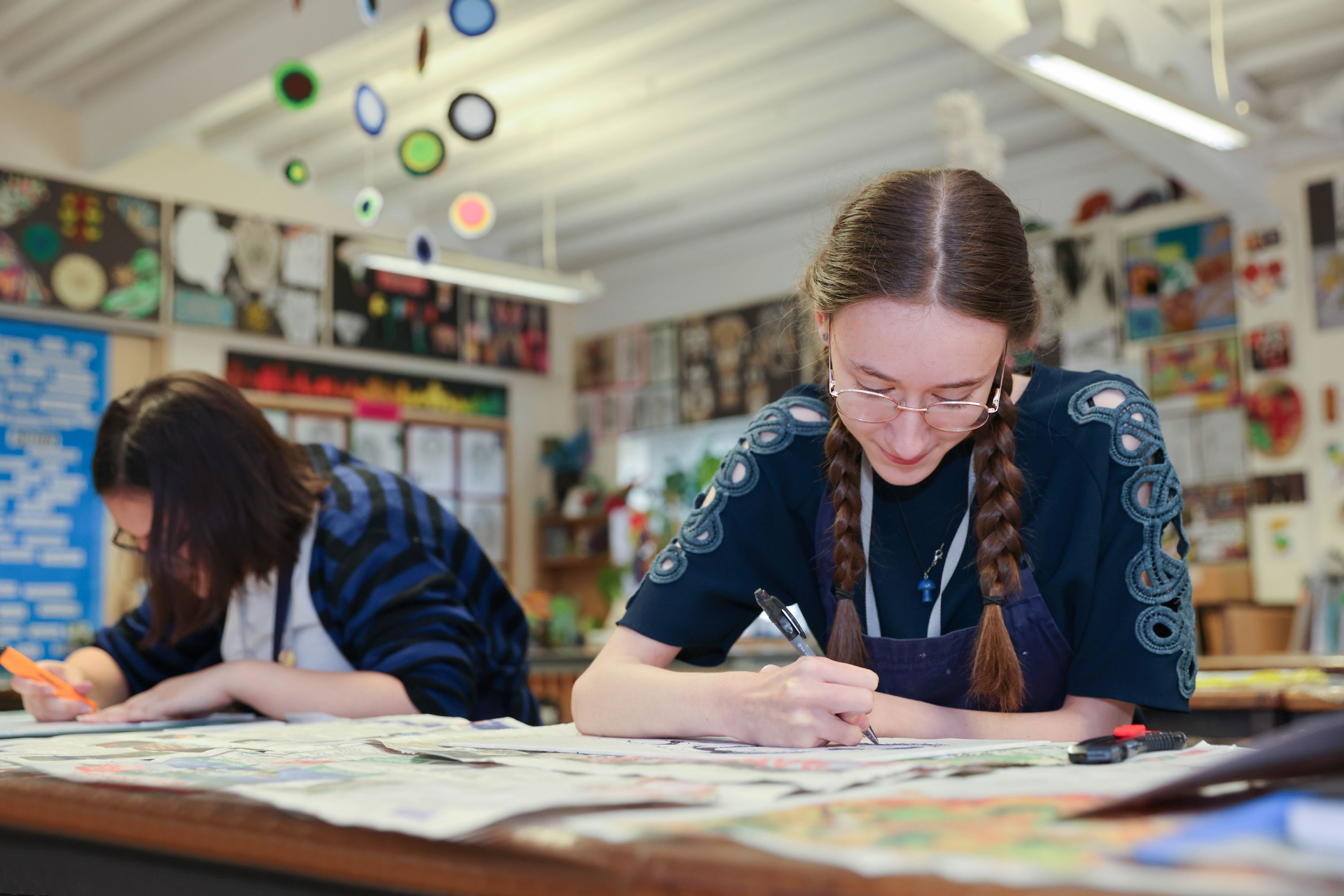
We also aim to support children in understanding and appreciating art from a variety of cultures, styles and periods of time. We want to promote children’s enjoyment of art through a broad and balanced curriculum which builds on previous work and achievements.
In addition to the National Curriculum aims, our ambitious curriculum for Art and Design at DSTC is designed:
- To build on their understanding of visual language, by researching and analysing the work of other artists, craftspeople and designers.
- To develop practical skills, through experimentation with a wide range of techniques and processes.
- To enable children to develop non-verbal means of organising ideas and expressing thoughts and feelings and record, communicate and express these ideas in different ways.
Complementary Subjects:
- Film studies and Media studies for advertising and marketing
- Physics and Maths for architecture
- Music, Performing Arts and Textiles for performance artists, costumes and fashion accessories
- Biology and Chemistry for skeletal structures, cell structures, plant and natural form studies and colour theory
- Computing for digital manipulation and photography
- English Literature and Language for creative writing and illustration
KS3
The National Curriculum for Art and Design aims to ensure that all students at Key Stage 2 can start to produce creative work whilst exploring ideas and recording experiences. At DSTC we have built a comprehensive and coherent scheme of work that develops those aims in greater depth. Students at Key Stage 2should start to become proficient in drawing, painting, sculpture and other art, craft and design techniques and our Key Stage 3 schemes of work are designed to focus specifically on these skills. At Key Stage 2, students have begun to evaluate and analyse creative works using the language of art, craft and design. Throughout Key Stage 3, our students analyse and evaluate a wide range of artists and designers' work, developing complex artistic language to describe their experiences and create a greater understanding of the historical and cultural development of the art forms they study.
|
|
Autumn 1 |
Autumn 2 |
Spring 1 |
Spring 2 |
Summer 1 |
Summer 2 |
|
Year 7 |
Drawing skills-tonal studies and mark making |
Drawing skills- cross hatching and pen and ink |
Drawing skills-still life drawing and drawing from observation |
Colour wheel, painting skills and colour theory |
Pop Art-Roy Lichtenstein responses |
Pop Art-Andy Warhol responses |
|
Year 8 |
Self Portraiture- artist responses |
Self Portraiture- Facial features and proportions |
Self Portraiture- tonal portrait from a photo |
Cultural artworks-(currently African Art) |
Cultural artworks-(currently African Art) |
Cultural artworks-(currently African Art) |
|
Year 9 |
Food studies-pencil, coloured pencils |
Food studies-Wayne Theibaud responses in paint |
Food studies-Clay sculptures |
Artist project-Front cover, artist research and 1st copy |
Artist project-self evaluation, 2nd copy in new media |
Artist project-final evaluation and opinion and 3rd copy using digital media |
At Key Stage 3, students have one lesson a week of Art and Design. Some of the main skills covered include:
- Group discussion around the meaning and messages of artwork.
- Using a variety of drawing materials to sketch, shade and blend tones.
- Using ink to create marks representing textures.
- Using clay to make a range of 3D sculptural pieces.
- Still life drawing, photographing and painting.
Students should be able to make assumptions as to what an artist’s message might be and explain their answers. Students should use problem-solving skills to mix and make a variety of colours by hand. Students should be able to keep effective time when printing multiple prints and use measuring to keep the work accurate.
Students should explore the time an art movement came about and be able to explain how historical events can influence artwork. Students should be able to make choices about which media would work best for a particular piece.
Students are not in sets for Art. Instead, they are in form groups. After school, we offer an art club where we can explore activities on a larger scale or sculptural pieces and the students can lead the sessions.
In Year 7 we cover two units. They are all skills-based and designed to introduce complex drawing and painting skills, which the students will not have covered at primary school. The first is drawing skills. We look at 3D shapes, tone bars, mark making and positive and negative space (we use this as a baseline assessment). The second is colour theory (colour wheel, colour types, shades, tints and shadows) and then POP art.
In Year 8, we start by focussing on self-portraiture. We explore a range of artists and their motivations behind making their self-portraits, then create a detailed, proportionally correct self-portrait. The second half of the year is for exploring a culture and its artwork.
In Year 9 we use still life food objects as the basis of our projects. The students make realistic food sculptures using clay and other materials. For the second half of the year, students choose female contemporary portrait artists to create a project on. The project is based on a mini GCSE project and can be used as additional work if they choose to take the subject at Key Stage 4.
Further Reading/Resources:
Galleries and Museums: Tate Modern, Tate Britain, The National Gallery, The National Portrait Gallery, Saatchi Gallery, The Hayward Gallery, The British Museum, The Victoria and Albert Museum, local galleries.
KS4
At Key Stage 4, students follow the AQA Art & Design: Fine Art Specification. They are taught in options groups and are allocated 3 hours per week. Students build on the knowledge and skills acquired at Key Stage 4, exploring and experimenting with a wide range of other processes, techniques and materials. They will develop investigative, analytical, experimental, practical, technical and expressive skills. Personalised plans are created and guidance is given on a 1:1 basis, to support each student individually.
Year 10 - Component 1 > Unit 1: Teacher led theme
Year 11
(Autumn Term) - Component 1 > Unit 2: Personal Choice (chosen from a selection of titles provided by teacher)
(Spring Term) - Component 2 > Externally Set Assignment: Exam Project (chosen from a selection of titles provided by AQA)
(Summer Term) - Component 2 > Externally Set Assignment: Practical Exam
For Component 1 (portfolio), students develop responses to initial starting points. They conduct independent research, record observations and select/experiment with appropriate media, materials, techniques and processes in order to develop and refine their ideas. For each project, students realise their intentions by creating a personal and meaningful response, which could have a functional or non-functional purpose.
Component 2 is an externally set assignment, with a starting point provided by AQA. Students will respond as above, providing evidence of their ability to work independently within specified time constraints. The outcome of this component will be created as part of a 10 hour practical exam.
|
|
Autumn 1 |
Autumn 2 |
Spring 1 |
Spring 2 |
Summer 1 |
Summer 2 |
|
Year 10 |
UNIT 1: Research and observational studies |
UNIT 1: Skills, techniques and experimentation |
UNIT 1: Personal Project Focus: Further research and observational studies |
UNIT 1: Personal Project Focus: Further technique development |
UNIT 1: Creation of final outcome |
UNIT 1: Creation of final outcome |
|
Year 11 |
UNIT 2: Research, observational studies, drawing and painting development |
UNIT 2: Creation of final outcome |
UNIT 2: Research, observational studies, drawing and painting development |
EXAM UNIT: Development of ideas/preparation for final outcome |
EXAM UNIT: Creation of final outcome (10 hour exam) |
|
Further Reading/Resources:
Books: AQA GCSE Art and Design: Student Handbook[Paperback] Martin Piercy (Author), Anne Stewart (Author), Frank Barnes (Author), Mike Ager (Author), Peter Dryland (Editor)
Exhibitions: Tate Modern and Britain, National Gallery, National Portrait Gallery, Saatchi Gallery, The Hayward Gallery, The British Museum, The Victoria and Albert Museum, Local galleries Etc
KS5
The 2 year AQA Fine Art A-level that we offer at DSTC links closely to the work studied at GCSE building on previous skills and techniques and developing a greater depth of understanding. Working in books, annotating and using a starting point are all covered in Years 10 and 11. Students have 15 hours to make a final piece and must produce an essay worth 50% of their mark.
The A Level course requires students to develop practical and theoretical knowledge and understanding of relevant materials, processes, technologies and resources. Students will choose their own investigation to pursue. They will decide on a question they want to explore or a theme they want to delve into in great depth. Students need to understand how ideas, feelings and meanings can be conveyed and interpreted in images and artefacts. Students need to demonstrate knowledge of how images and artefacts relate to a time and place in which they were made, and have an understanding of social / cultural contexts. Students must use specialist vocabulary and terminology.
The rigorous levels of study approached over the two year course means students are well equipped for a foundation course or Art degree. The portfolio created provides excellent examples of student’s practical skills. The personal investigation demonstrates students' ability to explore and research a theme in depth.
Subjects frequently studied after an A level in Fine Art include degrees in fashion design, graphic design, teaching, illustration and printmaking. Having an A level in fine art can also lead to careers in art therapy, interior design and architecture, photography, museum curation, floristry, make up, beauty and special effects work.
|
|
Autumn 1 |
Autumn 2 |
Spring 1 |
Spring 2 |
Summer 1 |
Summer 2 |
|
Year 12 |
Foundation style course, developing new techniques and researching their own artists |
Foundation style course, developing sustained pieces linked to their research and photos |
Personal investigation introduction: students choose a theme to explore and start to plan their projects |
Personal investigation- Choosing relevant artists and making responses to their work |
Personal investigation- Choosing relevant artists and making responses to their work |
Personal investigation- Creating sculptural pieces and large scale work based on their own research and photos |
|
Year 13 |
Personal investigation- Development of ideas/preparation for final outcome |
Personal investigation- Creation of final outcome/outcomes |
EXAM UNIT: Choosing their theme from the options provided and exploring through research and photography |
EXAM UNIT: Development of ideas/preparation for final outcome |
EXAM UNIT: Creation of final outcome (15 hour exam) |
|
Further Reading/Resources:
Galleries and Museums: Tate Modern, Tate Britain, The National Gallery, The National Portrait Gallery, Saatchi Gallery, The Hayward Gallery, The British Museum, The Victoria and Albert Museum, Natural History Museum, Science Museum, local galleries.
- Book: '…isms' by Stephen Little
- Book: The Story of Art by Ernst Gombrich
- Book: Art Today by Edward Lucie-Smith
- Book: What are you looking at? By Will Gompertz
- Book: Why Your Five Year Old Could Not Have Done that: Modern Art Explained by Susie Hodge
- Book: Visual Arts for the IB Diploma Coursebook
- Websites: www.npg.org.uk, www.art.com, www.tate.org.com, www.artareas.com,, www.artcyclopedia.com, www.artlex.com