

Design Engineering
Curriculum Intent
In addition to the National Curriculum aims, our ambitious curriculum for Design Engineering at DSTC is designed:
- To encourage problem-solving skills
- Build on developing their own iterative design skills between designers and users.
- Establish confident making skills, while self-evaluating along the way.
Complementary Subjects:
- Science for understanding material properties, forces and movement.
- Art and Design for expressing ideas through design and creativity.
- Geography for environmental issues,used to develop sustainable solutions.
- Maths for measurement and conversion.
- IT for using computer-aided design (CAD) software and computer-aided manufacturing (CAM) systems.
KS3
At Key Stage 2-3, students are taught to generate, develop, model and communicate their ideas through discussion, annotated sketches, prototypes and computer-aided design. Arts and crafts play a big role in developing a student's ability to work with and understand materials and 3D models and this will be an area to build from to help nurture success.
Design Technology at Key Stage 3 will require students to develop these key transferable skills such as evaluation, critical thinking and problem-solving. We nurture imagination and the willingness to accept failure as an integral part of progress.
|
Year 7 Pull along toy |
Year 8 Jewellery box |
Year 9 Anglepoise lamp |
|
Drawing skills Basic cutting skills
|
Developing of cutting skills Machinery skills Drawing communication |
Machinery skills Electronic component |
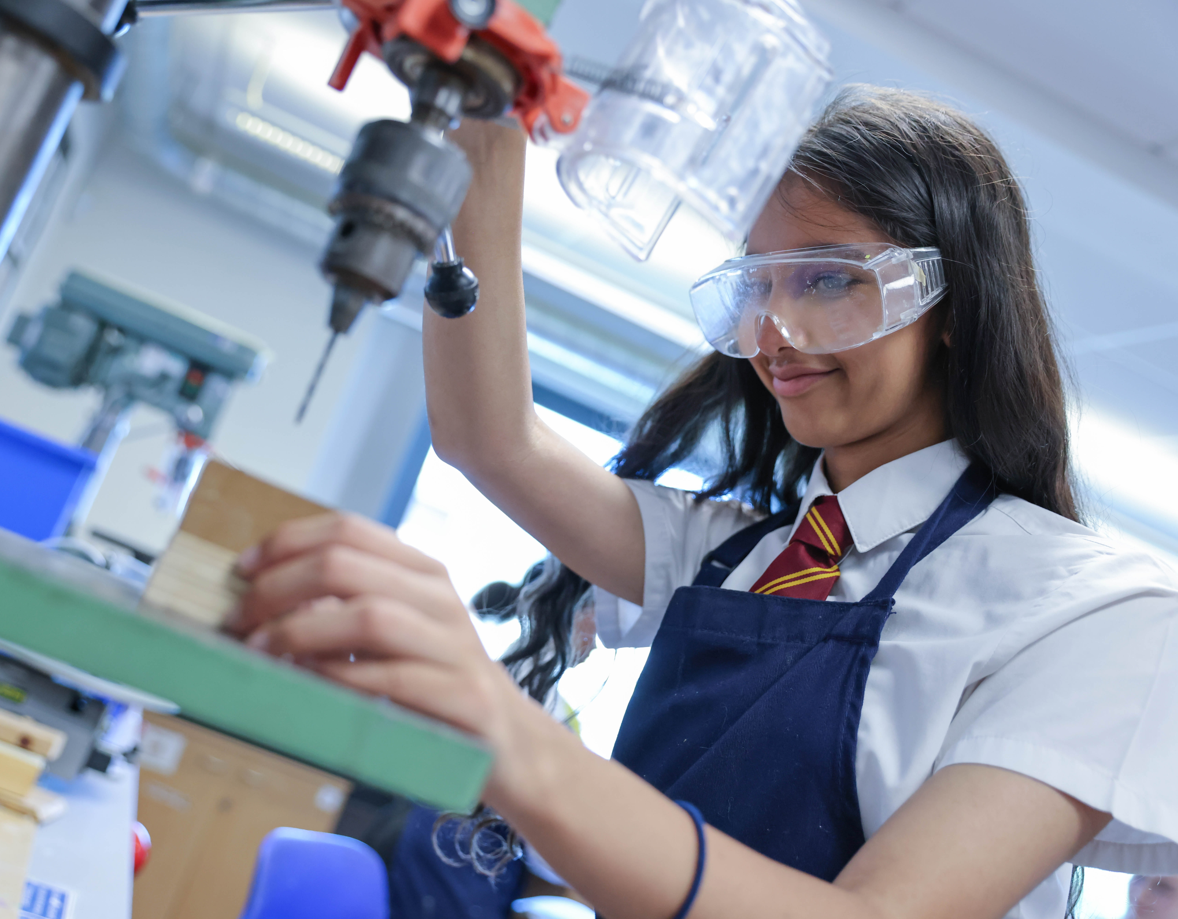
Through a variety of creative and practical activities, students will be taught the knowledge, understanding and skills needed to engage in a process of designing and making. Students will develop and communicate design ideas using annotated sketches and detailed plans. 3-D and mathematical modelling will be key factors to develop the subject further. Students will be able to independently select and use specialist tools, techniques, processes, equipment and machinery precisely, including computer-aided manufacture.
In Year 7, students design and make a pull-along toy, whilst in Year 8 they build on these skills to manufacture a jewellery box. The final project in Year 9 is designing and making an Anglepoise lamp following a template.
KS4
Design and Technology at Key Stage 4 sets out the knowledge, understanding and skills required to undertake the iterative design process of exploring, creating and evaluating. The majority of the course is delivered through the practical application of this knowledge and understanding. Building on their knowledge from Key Stage 3, students will manufacture complex and varied products to ensure a level of practical understanding which can be applied to independent design and problem-solving.
We follow the AQA Design and Technology GCSE specification. The students have 3 lessons per week (2 lessons of practical application, 1 lesson of theory and written work). Homework will support written theory tasks and learning of subject topics. There is also a dedicated after school intervention one evening a week with another drop in day optional for students to help them gain the best marks possible in their coursework.
Students must also demonstrate mathematical and scientific knowledge and understanding, in relation to design and technology.
|
|
Autumn 1 |
Autumn 2 |
Spring 1 |
Spring 2 |
Summer 1 |
Summer 2 |
|
Year 10 |
New & Emerging Technology Evaluation and design decision
End of unit test |
Energy: generation and storage Development in new material
End of unit test |
System approach to designing Mechanical devices
End of unit test |
Material and their working properties Specialist technical properties End of unit test
|
Scale of production Timber
End of unit test |
NEA contextual challenge released Revision |
|
Year 11 |
NEA REVISION |
NEA REVISION |
NEA REVISION |
NEA REVISION |
EXAM REVISION |
|
Further Reading/Resources:
-
Pocket size revision guide GCSE design and technology
-
Edexcel GCSE Design and Technology