

Hospitality and Catering
Curriculum Intent
Throughout the Food, Hospitality and Catering strand, we want students to develop their practical skills alongside relevant food knowledge.
Our curriculum will provide life skills that will foster a further interest in this area so that students can make positive, informed life decisions on food production, provenance, food preparation and positive food choices for health.
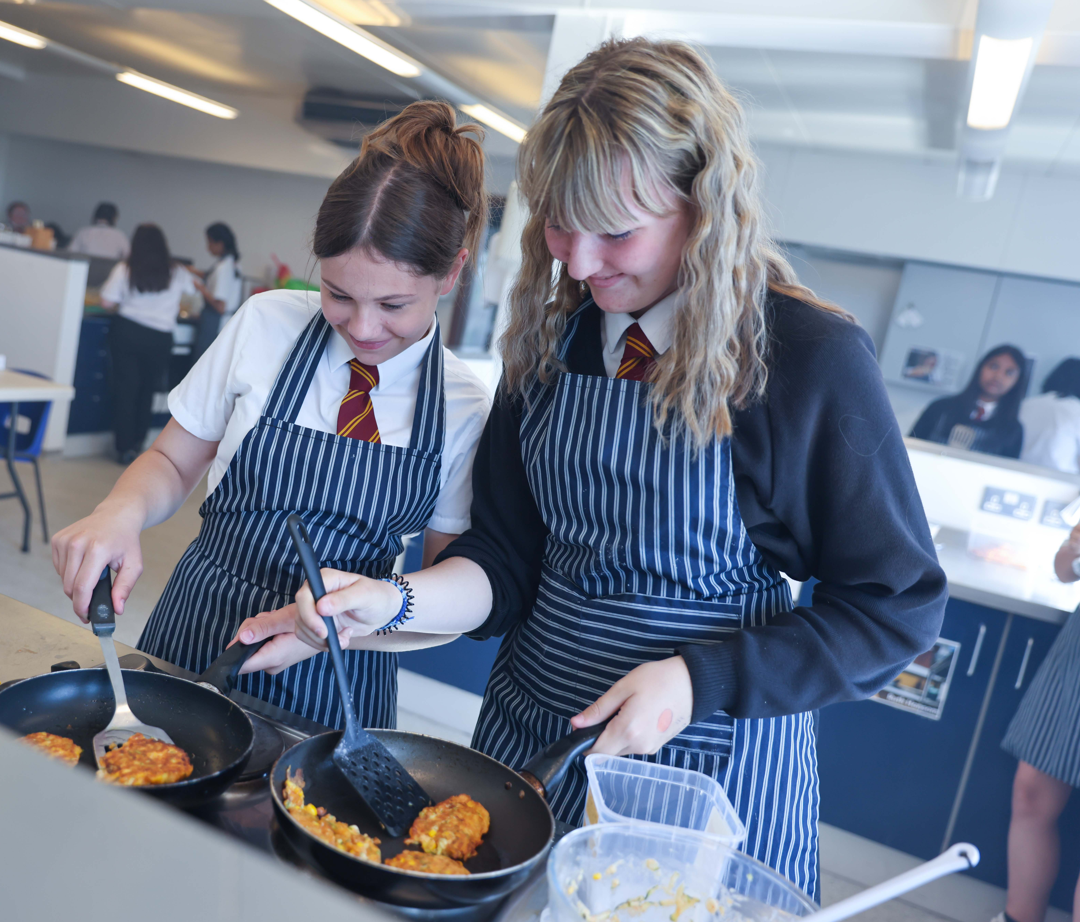
The food curriculum will give students the opportunity to:
- Study a variety of different cooking methods and learn the nutritional impact of each one
- Understand a variety of nutrients and their positive and negative effects on the individual
- Experiment with ingredients and techniques they are unfamiliar with
- Create a vast number of dishes to demonstrate their skills in both savoury and sweet recipes
- Analyse the various styles of hospitality and catering styles and establishments
- Evaluate their own and others' practical skills
- Learn how to develop menus that consider customer needs
- Develop an understanding of how environmental issues impact his sector
- Develop an understanding of a varied range of job roles and responsibilities within the sector
In addition to the National Curriculum aims, our ambitious curriculum for Hospitality and Catering at DSTC is designed to:
- Develop their love of food, flavour, textures and ingredients.
- Embed lifelong practical skills.
- Assist students in understanding the nutrition and provenance of foods and make informed dietary choices.
Complementary Subjects:
- Science for the chemical processes of cooking and changes in nutrition.
- English Literature and language for understanding and developing food language and writing.
- Maths for adaptation of recipes – USA to UK or changes to quantities.
- Art/Design for the creative and design elements of food preparation and presentation.
KS3
In Key Stage 3, we focus on basic skills and apply them to cooking methods so that students can use kitchen equipment and prepare food effectively and safely.
All recipes in Years 7–9 are designed to use a specific food group, skill or piece of equipment so that all students will leave Key Stage 3 with a well-rounded repertoire of dishes and skills.
In Year 7, we will start with basic processes such as using a knife and then move on to different parts of the cooker.
In Year 8 we introduce dishes that involve a variety of techniques with one recipe.
In Year 9 we start to make full dishes that can be used as they are or adapted to suit for tastes or amounts needed.
All recipes are designed to be time pressured to ensure students are learning speed and precision as we go though Key Stage 3.
Recipes may change depending upon student voice / feedback.
Homework is designed to underpin other elements of the practical such as nutrition, hygiene, animal welfare, farming, fairtrade the environment and provenance
|
|
Term 1 (a) |
Term 1 (b) |
|
Year 7 |
Fruit Salad: Hygiene Chopping skills Pasta Salad: Boiling Apple Crumble: Baking Cauliflower Cheese: Multi tasking / Gelatinisation Brownies: Readiness |
Bread: Kneading Rock Cakes: Rubbing In Sausage Rolls: Portioning Chicken nuggets: Baking, presentation
|
|
Year 8 |
American pancakes: Frying Thai green Curry: Preparation / knife skills Scotch eggs: Multi tasking Chocolate Chip Cookies: Forming/Portioning Meatballs and Pasta: Readiness of protein Naan Bread: Rolling / Griddling
|
Chocolate & Vanilla Pinwheels: Precision Lemon drizzle: Zesting / measuring / readiness. Stir Fry - Mise en place Cheese scones - Shaping Panzanella - Budgeting Strawberry Cupcakes - Seasonality / Provenance
|
|
Year 9 |
Portuguese Custard Tarts: Speed / Precision Pasta: Engineering Lasagne: Multi-tasking IKEA meatballs: Cost analysis Scones: Accurate Weighing Tuscan Chicken: Core Temperatures
|
Gochujang Pasta: Frying / Boiling / Reducing Garlic Bread: Advanced knife skills Swiss Roll: Folding / Rolling Kiev: Advanced butchery / animal welfare Jaffa Muffins: Precision / Speed Pizza / Doughballs: |
Further Reading/Resources:
TV shows: take time to watch food shows. Masterchef, Gordon Ramsey etc. These will increase your exposure to food and techniques.
KS4
In Key Stage 4, students follow the L1/2 WJEC Hospitality and Catering course. The NEA (non-examined assessment), otherwise known as coursework, is 60% of the course and concludes with a 4 hour practical based upon a set brief. The final 40% is an exam.
Students will undertake trips where it will actively aid learning.
|
|
Autumn 1 |
Autumn 2 |
Spring 1 |
Spring 2 |
Summer 1 |
Summer 2 |
|
Year 10 |
High-end practical skills |
High-end practical skills |
NEA (non examined assessment) |
NEA (non examined assessment |
Practical |
Exam Preparation |
|
Year 11 |
Exam Preparation`for Jan exam |
High-end practical skills |
High-end practical skills |
High end practical skills |
Exam Preparation`for June exam (if needed) |
High end practical skills |
Further Reading/Resources:
- Any further reading/ resources will be supplied and uploaded to Google Classroom.
- Watch food programs to increase knowledge and exposure of food - Masterchef: Professionals, Saturday kitchen
- Websites such as BBC GoodFood, Mobkitchen are helpful for ideas.