

Maths
Curriculum Intent
The ambition of the Mathematics Faculty at DSTC is for students to become independent, resilient and capable mathematicians. We do this by ensuring students have a deep, secure understanding of mathematical concepts. Our curriculum is built around the idea of taking small, manageable steps to ensure that all learners progress at their own pace. This approach builds a solid foundation, helping students develop fluency and problem-solving skills. By revisiting and revising key concepts, we ensure that students are not just memorising procedures but are equipped to apply their knowledge in a range of contexts.
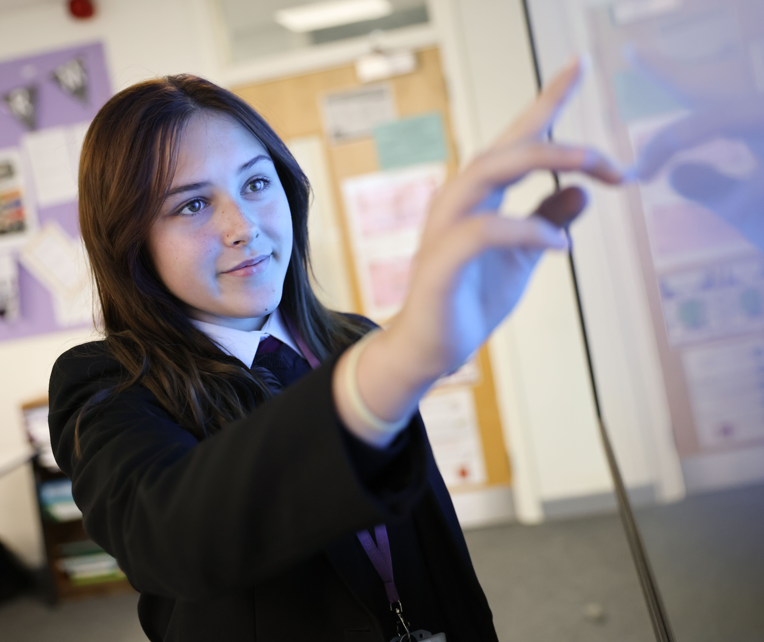
We want our students to have a genuine love of Mathematics and encourage them to see its relevance not only in the classroom but in the world around them, whether that be calculating costs, interpreting data or solving problems.
Through exposure to female role models, we aim to inspire all students—especially girls—to see mathematics as a powerful tool for their future careers. We provide opportunities for students to explore the wide range of career options available to those who study mathematics, from engineering to finance, computer science to data analysis, and beyond..
In addition to the National Curriculum aims, our ambitious curriculum for Mathematics at DSTC is designed:
- To foster resilience, by allowing students to take risks and learn from mistakes.
- Develop a sense of curiosity and make connections.
- Ensure every student can make progress in maths, no matter what their starting point is.
Complementary Subjects:
- Science and Medicine
- Geography
- Business and personal finance
- Computing
- Design Engineering
KS3
In Key Stage 3 we continue to build on Key Stage 2 knowledge following an adaptive Mastery curriculum designed with small steps, depth and breadth so all students can be successful. We encourage students to explore new learning by using multiple methods, including, physical, visual, abstract methods enabling them to develop their understanding of concepts and relate this to problem-solving and the real world. We also encourage students to communicate mathematically, encouraging discussions as we know students learn maths effectively when they work together.
Key Stage 3 is currently taught in ability classes, so adaptive teaching ensures all students make progress.
|
|
Autumn 1 |
Autumn 2 |
Spring 1 |
Spring 2 |
Summer 1 |
Summer 2 |
|
Year 7 |
Sequence Place Value Number |
Directed number Algebraic notation and equations |
Averages FDP Time |
Data Fractions and percentages of amounts |
Types of number Fractions (add/subtract) |
Perimeter and area Angles |
|
Year 8 |
Ratio and proportion Algebraic manipulation |
Graphs Fractions (multiply and divide) Standard form |
Symmetry and reflection Area and volume Solving equations and inequalities |
Percentages Indices Sequences |
Angles Data
|
Probability Circles |
|
Year 9 |
Angles Representing Data Measures of location Percentages |
Maths and Money Numbers |
Pythagoras’ theorem Equations Probability
|
Linear Graphs Constructions |
3D shapes Ratios Rates Angles |
Enlargement & Similarity Rotation & Translation |
Further Reading/Resources:
The following book suggestions from the Maths Department
- The Number Devil by Hans Magnus Enzensberger
- Any Book by Rob Eastway including:
- Maths on the back of an envelope
- Why do buses come in threes?
- How long is a piece of string
- UKMT Maths challenge
KS4
Students will be entered for the GCSE in Mathematics at the end of Key Stage 4, there are two tiers of entry; Foundation and Higher. The appropriate tier will be chosen using an evidence-based approach in order to ensure students achieve their full potential. During Key Stage 4 students will be set, according to ability.
In Key Stage 4, students will study a wide range of mathematics across all strands of the curriculum: algebra, geometry, number, data, probability and ratio and proportion that continues to build on their Key Stage 3 knowledge.
Use of past exam questions and walking talking mocks ensure students become familiar and confident with mathematical language and problem-solving. Personalised QLAs after PPE’s and the use of Sparx and Google Classroom encourage students to become independent learners.
|
|
Autumn 1 |
Autumn 2 |
Spring 1 |
Spring 2 |
Summer 1 |
Summer 2 |
|
Year 10 |
Rotation & Translation Congruency Similarity Averages |
Representing Data Inequalities |
Simultaneous Equations Ratios & Fractions |
Non-calculator methods Trigonometry Angles & Bearings
|
Circles Percentages Probability
|
Sequences Indices and roots Vectors
|
|
Year 11 |
Indices Multiplicative Reasoning Gradients and Lines Non Linear graphs |
Expanding Factorising Solving Equations Collecting, Representing and interpreting data |
Trigonometry Working with circles |
Functions Vectors |
Constructions and Loci Algebraic Reasoning |
Revision |
Further Reading/Resources:
The following books and resources are recommended by the Mathematics Department:
- Murderous Maths by Kjartan Poskitt A set of 10 books spanning topics from basic arithmetic to the Quadratic Formula
- My Best Mathematical and Logic Puzzles by Martin Gardner
- Enigma by Robert Harris
- The Man who counted infinity and other short stories by Saso Dolenc
KS5
A Level Mathematics continues to build on prior knowledge from Key Stage 4 where topics such as indices, surds and quadratic equations are revisited in more depth with more emphasis on problem-solving and modelling of real life scenarios. Students will study three main strands; Pure Mathematics, Statistics and Mechanics.
Studying A Level Mathematics develops skills of logical thinking, problem-solving and decision making; skills that are highly valued by employers and universities across a huge variety of sectors.
We are also introducing Level 3 Core Maths at Key Stage 5 so more girls have access to studying maths beyond GCSE and make more connections to the Maths used in the real world.
|
|
Autumn 1 |
Autumn 2 |
Spring 1 |
Spring 2 |
Summer 1 |
Summer 2 |
|
Year 12 |
Algebra and functions Statistical Sampling Modelling in Mechanics |
Coordinate geometry in the (x, y) plane Further algebra Kinematics 1 |
Trigonometry Data Presentation and Interpretation Probability Constant Acceleration |
Vectors (2D) Differentiation Probability Forces and Newton's Law |
Integration Exponentials and Logs Statistical Hypothesis testing Kinematics 2 |
Revision Proof Algebraic Fractions |
|
Year 13 |
Functions and Modelling Regression Moments |
Trigonometry Probability Forces at an angles |
Differentiation The Normal Distribution Application of Kinematics |
Integration
Application of forces |
The Normal Distribution Further Kinematics
|
Examinations |
|
|
Autumn 1 |
Autumn 2 |
Spring 1 |
Spring 2 |
Summer 1 |
Summer 2 |
|
Year 12 Core Maths |
Numerical calculations Percentages Interest rates
|
Repayments & credit Graphical representation Taxation
|
Solution to financial problems The modelling cycle Fermi estimation
|
Types of Data Collecting Data Representing data numerically
|
Representing data diagrammatically Critical analysis of data and models Logical arguments
|
Communicating mathematical approaches Revision |
|
Year 13 Core Maths |
Communicating mathematical solutions Analysing critically
|
The normal distribution Notation |
Calculating probabilities from the normal distribution Population and sample |
The mean of sample size n Confidence intervals |
Correlation The product moment correlation coefficient Regression Lines |
Examinations |
Further Reading/Resources:
The Mathematics department recommend the following books:
Mathematicians:
- 3 A Tribute to Euler (You tube) by William Dunham
- 3 A Beautiful Mind - The Life of Mathematical Genius and Nobel Laureate John Nash by Sylvia Nasar .