

Music
Curriculum Intent
We study Music at DSTC to challenge ourselves to explore, refine and improve our creative responses and skills.The Music curriculum allows DSTC students to gain an appreciation and understanding of the rich and varied history of music from all around the world.
We study Music to develop transferable skills that we will inevitably use in all other areas of our learning, tapping into multiple skill sets often simultaneously.
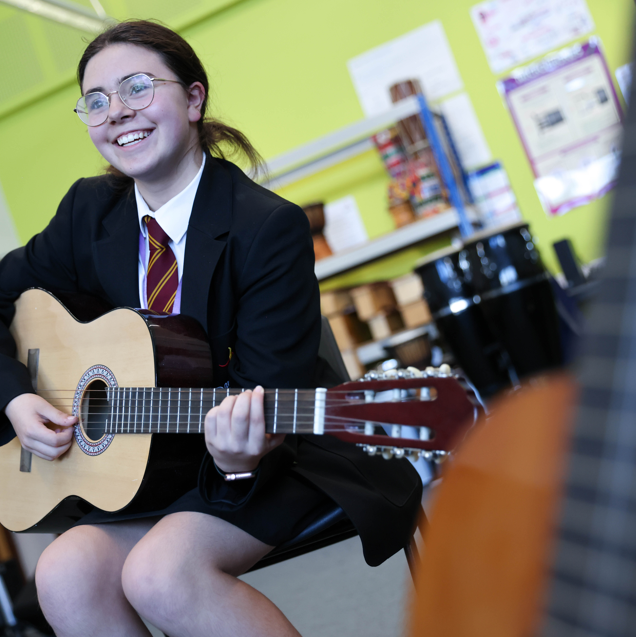
In addition to the National Curriculum aims, our ambitious curriculum for Music at DSTC is designed:
- To develop resilience, self discipline, communication and confidence through individual and group performance, ensemble and rehearsal.
- To nurture creative curiosity by exploring various genres and styles and encourage ‘thinking out of the box’.
- To provide extra-curricular activities and performance opportunities for all students, including Choir, DSTC Radio, Podcast production and Band workshops.
Complementary Subjects:
- Dance
- Performing Arts
- English
- Media
- IT
- Art
KS3
Students will have experienced some Music at primary school, however the themes and genres will have varied, and therefore at DSTC it is crucial for our students to have greater exposure and broader experiences in order to build on their compositional and performance opportunities.
|
|
Autumn 1 |
Autumn 2 |
Spring 1 |
Spring 2 |
Summer 1 |
Summer 2 |
|
Year 7 |
Exploring Global Rhythms and Melodies: Dynamics, Rhythm and Pitch |
Exploring Global Rhythms and Melodies: Dynamics, Rhythm and Pitch |
Texture, Timbre, and Keyboard Skills and Harmony |
Texture, Timbre, and Keyboard Skills and Harmony |
Structure and Ensemble Performance |
Structure and Ensemble Performance |
|
Year 8 |
Blues |
Keyboard Skills |
Indian Classical Music |
Signature Tunes |
Rap and Hip Hop |
Performance skills |
|
Year 9 |
Songwriting |
Minimalism |
Musical Theatre |
EDM |
Film Music |
Planning a Music Festival |
The whole of the Key Stage 3 curriculum requires students to be able to collaborate by composing and performing, and therefore enhancing and embedding their skills. They develop a passion and understanding of music and are encouraged to show critical analysis of music through listening to music. We aim to show the impact of the diversity of music by studying different cultural and historical influences.
We encourage students to have creative curiosity and be courageous in the development of their ideas. Therefore, developing the confidence of our students is another vital part of our curriculum and students are frequently challenged to perform their ideas and present their compositions to each other, whilst being encouraged to evaluate the success of these performances.
Further Reading/Resources:
- The AB Guide to Music Theory (Part I) – Eric Taylor
- How to Read Music – Roger Evans
- Composing Music – William Russo, David Stevenson & Jeffrey Ainis
- Why Is This Song Amazing? – Nate Sloan & Charlie Harding
KS4
At Key Stage 4, we offer BTEC Music to ensure that the curriculum is inclusive and suitable for all. BTEC Music introduces students to the world of music careers and a greater understanding of the music industry. It is taught in a way where students are encouraged to take creative control and arm them with highly developed musical skill, knowledge and understanding. Our schemes of work is in line with those approved by the exam board and adapted to suit learners. Music is taught for three hours a week.
In the first year of the course, students will gain skills and understanding in three main areas:
- Performance skills
- This can be instrumental, vocal or technology-based performing (ie. DJing, live looping, control devices)
- Composition skills
- Students can use traditional notation (written or software-based) or by using DAWs (Digital Audio Workstations) or other suitable technology.
- Production skills
- Students will use Digital Audio Workstations (DAWs) such as 'Mixcraft' and 'Logic Pro'.
In the second year, students will follow two of those areas. One will be production and the other is a choice of performance or composition. The course is assessed both internally and externally; Component 1 and 2 are internal and Component 3 is external.
|
|
Autumn 1 |
Autumn 2 |
Spring 1 |
Spring 2 |
Summer 1 |
Summer 2 |
|
Year 10 |
Component 1 – Exploring Music Products and Styles |
Component 1 – Exploring Music Products and Styles |
Component 1 – Exploring Music Products and Styles |
Component 1 – Exploring Music Products and Styles |
Component 2 – Music Skills Development |
Component 2 – Music Skills Development |
|
Year 11 |
Component 2 – Music Skills Development |
Component 2 – Music Skills Development |
Component 3 – Responding to a music brief |
Component 3 – Responding to a music brief |
|
|
Further Reading/Resources:
- What Is Music Production? – Russ Hepworth-Sawyer & Craig Golding
- Buy link (Routledge)
- BBC Bitesize: Music Genres & Styles
- Visit: BBC Bitesize Key Stage 4 Music
- Soundfly: Genre Deep Dives
- Visit: https://soundfly.com/blog
- How to Write Great Music: Understanding the Process – William Russo
- MusicTech Student Portal
- Visit: https://musictechstudent.co.uk
- The Music Industry Handbook – Paul Rutter (for teachers/advanced students)