

Science
Curriculum Intent
The aim of Science at DSTC is to educate & empower scientific students for the future, by fostering an enthusiasm that lasts a lifetime. We aim to develop a variety of transferable skills that can be used to help them progress in many disciplines including data gathering, manipulation, analysis & interpretation, independence, teamworking, practical & research skills. Our students will become critical thinkers with regards to science media & knowledge they are confronted with in order to make informed decisions throughout their lives. Furthermore, we aim to encourage many girls to continue studying science at a higher level and give them opportunities to see themselves and people like them as scientists by presenting images and examples of females doing important jobs within science fields.
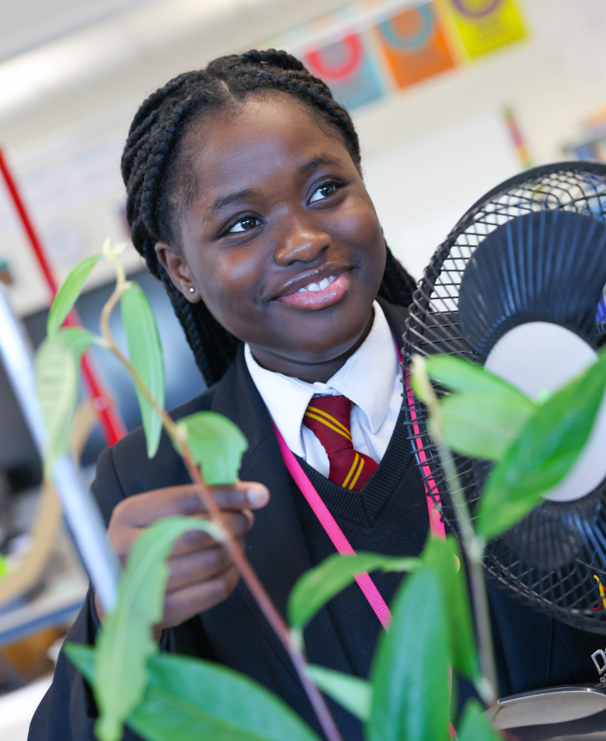
In addition to the National Curriculum aims, our ambitious curriculum for Science at DSTC is designed to:
- Ignite all students with a passion for science
- Develop intellectual curiosity regarding the world around them
- Embrace technology whilst being compassionate about the environment
Complementary Subjects:
Maths for access to medicine, Criminology and Psychology for forensics, Health and Social care for nursing and social care, Geography for environmental careers.
KS3
Key Stage 2 learning focuses on the scientific method and some basic knowledge in science. We aim to build on this by developing the working scientifically skills to include using data and more complex graphs and delving more deeply into ideas like precision, accuracy, error and repeatability. We also teach how evidence helps us develop our scientific understanding and how peer review is used in real life to check our theories. In terms of scientific knowledge and understanding we challenge students to make links between the 3 scientific disciplines and relate scientific explanations to the real world.
Students will also be encouraged to use modelling and abstract ideas to develop explanations in science. Concepts introduced at Key Stage 3 are embedded with practical work to ensure students are prepared when they enter Key Stage 4.
|
|
Autumn 1 |
Autumn 2 |
Spring 1 |
Spring 2 |
Summer 1 |
Summer 2 |
|
Year 7 |
Matter and cells |
Forces and separating techniques, |
Body systems and space |
Acids and alkalis, reproduction
|
Chemical reactions and motion |
Health and lifestyle |
|
Year 8 |
Health and lifestyle, Periodic table |
Acids and light |
Bioenergetics and reactions |
Sound, adaptations and inheritance |
Reactions and metals, motion and pressure |
Earth |
|
Year 9 (Topics are staggered to allow for resource availability) |
Cells and Transport, States of Matter and Methods of Separating and Purifying Substances, and Motion and Forces |
Cells and Transport, States of Matter and Methods of Separating and Purifying Substances, and Motion and Forces |
Cells and Transport, States of Matter and Methods of Separating and Purifying Substances, and Motion and Forces |
Enzymes, Health, Disease and The Development of Medicines, Atomic Structure and The Periodic Table, and Conservation of Energy |
Enzymes, Health, Disease and The Development of Medicines, Atomic Structure and The Periodic Table, and Conservation of Energy |
Enzymes, Health, Disease and The Development of Medicines, Atomic Structure and The Periodic Table, and Conservation of Energy |
Students work through a specifically devised scheme of work, that incorporates all aspects of the National Curriculum with all the 'working scientifically' skills included. They are taught in mixed ability sets with one grammar set (tutor groups) and we aim to give Key Stage 3 one teacher so that they are able to form strong relationships. They have 4 lessons per week.
Students are included in science trips during activities weeks and British science week activities during March. They are also invited to the Science club.
Further Reading/Resources:
The following book suggestions from the Science Department will enable students to push their understanding beyond the content covered in lessons and continue to enthuse the next generation of scientists and inventors.
- Nick Arnold, Horrible Science Collection
- Jeanne Bendick, Galen and the Gateway to Medicine
- Clive Gifford, Ground Control to Major Tim
- Chris van Tulleken & Xand van Tulleken, Your Brilliant Body (Operation Ouch!)
- Dara O’Briain, Beyond the Sky and the Universe
- David Attenborough, Life on Earth
- David Thorpe, Hybrids
- Douglas Adams, The Hitchhiker’s Guide to the Galaxy
Useful websites
- https://www.bbc.co.uk/bitesize/subjects/zng4d2p
- A link to the Key Stage 3 Assessment booklet will also be made available here.
KS4
Students study Edexcel Combined Science or Edexcel Separate Sciences - Biology, Chemistry and Physics at GCSE. We follow the Pearsons scheme of work with some amendments to focus and consolidate the working scientifically skills and required practicals. Students are taught in mixed ability sets with one higher tier set and two triple classes. They have 5 lessons per week for Combined Science and 8 lessons per week for Triple Science. Triple Science lessons are always taught with a specialist in each of the Sciences. Year 11 assessments use past exam questions to help familiarise students with the language & depth needed to achieve.
The use of command worlds during lessons also helps embed key skills with regards to exam techniques. Intervention is used to fill gaps in knowledge identified by topic assessments & classwork. A blended learning approach is being further developed with more use of google classroom, independent learning and digital resources to support the work done in the classroom.
|
|
Autumn 1 |
Autumn 2 |
Spring 1 |
Spring 2 |
Summer 1 |
Summer 2 |
|
Year 10 |
All Sciences: Cells and Control, Ionic Bonding, Covalent Bonding, and Types of Substances, and Waves
|
Combined Science: Genetics, Ionic Bonding, Covalent Bonding, and Types of Substances, Light and the Electromagnetic Spectrum |
Combined Science: Natural selection and genetic modification, Acids and Alkalis, Radioactivity
|
Combined Science: Natural selection and genetic modification, Calculations Involving Masses, Forces doing work, Forces and Their Effects |
Combined Science: Plant Structures and their Functions, Electrolytic Processes, Obtaining and Using Metals, Reversible Reactions and Equilibria |
Combined Science: Groups in the periodic table, Electricity and circuits
|
|
Separate Science: Genetics, Acids and Alkalis, Calculations Involving Masses, Light and the Electromagnetic Spectrum |
Separate Science: Natural selection and genetic modification, Electrolytic Processes, Obtaining and Using Metals, Reversible Reactions and Equilibria, and Transition Metals, Alloys, and Corrosion, Astronomy |
Separate Science: Natural selection and genetic modification, Groups in the Periodic Table, Radioactivity |
Separate Science: Plant Structures and their Functions, Quantitative Analysis, Dynamic Equilibria and Calculations Involving Volumes of Gases, Forces doing work, Forces and Their Effects |
Separate Science: Chemical Cells and Fuel Cells, Electricity and circuits and Static electricity |
||
|
Year 11 |
Combined Science: Genetics (The structure and function of DNA), Rates of reaction, and Electricity and circuits
|
Combined Science: Genetics (Inheritance), Heat energy changes in chemical reactions, Magnetism and the motor effect and Electromagnetic induction |
Combined Science: Natural selection, Fuels, and The Particle Model
|
Combined Science: Genetic Modification, Earth and Atmospheric Science, and Forces and Matter
|
Review Period |
Exam Period |
|
Separate Science: Genetics (The structure and function of DNA), Rates of reaction and Heat energy changes in chemical reactions. and Electricity and circuits and Static electricity |
Separate Science: Genetics (Inheritance), Fuels, Earth, and Atmospheric Science, and Magnetism and the motor effect and Electromagnetic induction |
Separate Science: Natural selection, Hydrocarbons, Alcohols & carboxylic acids, Polymers, and The Particle Model |
Separate Science: Genetic Modification, Qualitative analysis: Tests for ions, Bulk & surface properties of matter inc nanoparticles, and Forces and Matter |
Further Reading/Resources:
The following book suggestions from the Science Department will enable students to push their understanding beyond the content covered in lessons and continue to enthuse the next generation of scientists and inventors.
- Bill Bryson, A Short History of Nearly Everything
- Stephen Hawking, Brief Answers to the Big Questions.
- Sam Kean, The Disappearing Spoon: And Other True Tales of Madness, Love, and the History of the World from the Periodic Table of the Elements.
- David Attenborough, The Private Life of Plants.
- Charles Darwin, The Origin Of Species
Useful websites
- Free science lessons https://www.freesciencelessons.co.uk/
- Fuse school https://www.youtube.com/@fuseschool/videos
- Cognito https://www.youtube.com/@Cognitoedu/videos
- BBC bitesize https://www.bbc.co.uk/bitesize/subjects/zrkw2hv
- Physics and maths tutor https://www.physicsandmathstutor.com/
- A link to the Year 9 Options booklet will also be made available here.
KS5
Pathways at DSTC can include A-levels in Biology and Chemistry. Many of our students aim to go on to study aspects of Science, Nursing or Health and Social care subjects like Early years practitioners.
Outside of the classroom, our Science students will be given the opportunity to enrich their knowledge and passion for the subject through some of our exciting trips. These include a residential trip for Biology and Environmental science, visiting universities to gain an insight into further study opportunities or receiving exciting lectures on up and coming Science.
|
|
Autumn 1 |
Autumn 2 |
Spring 1 |
Spring 2 |
Summer 1 |
Summer 2 |
|
Year 12 |
||||||
|
Biology |
Cell structure, Biological molecules, Biological membranes |
Enzymes, Cell division, nucleic acids and protein synthesis |
Gas exchange surfaces, transport in plants and animals |
Communicable diseases and the immune response, heart and cardiac cycle |
Classification, biodiversity & evolution |
Ecosystems and nutrient cycles |
|
Chemistry
|
Foundations in Chemistry |
Foundations in Chemistry |
Periodic Table and Energy |
Periodic Table and Energy |
Core Chemistry |
Core Chemistry |
|
Year 13 |
||||||
|
Biology |
Homeostasis, hormonal communication, photosynthesis |
Respiration, nervous coordination, statistics |
Excretion and liver, anaerobic respiration, animal responses |
Cellular control, kidney, muscle structure and function |
Patterns of inheritance, manipulating genomes, genetic engineering |
|
|
Chemistry
|
Physical Chemistry and Transition Elements |
Physical Chemistry and Transition Elements |
Organic Chemistry and Analysis |
Organic Chemistry and Analysis |
Revision |
|