

Textiles
Curriculum Intent
The curriculum aims to inspire students to invent, experiment and create, in the areas of art, craft and design.
Skills developed will equip students for further education and employment, contributing to their personal development in creativity, independence, resilience and self reflection.
With high expectations, students are provided with appropriate levels of challenge, as well as being given personalised guidance and support.
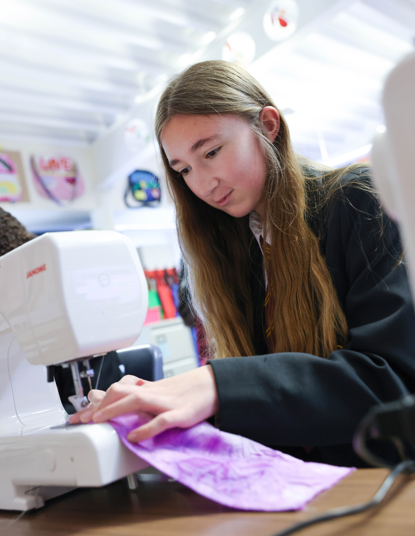
In addition to the National Curriculum aims, our ambitious curriculum for Textiles at DSTC is designed:
- To build on their understanding of visual language, by researching and analysing the work of other artists, craftspeople and designers
- To develop practical skills, through experimentation with a wide range of textiles techniques and processes
- To enable students to reflect on their own work, identifying strengths and areas to develop
Complementary Subjects:
- Media Studies - for advertising and marketing
- Business - for company development
- Physics and Maths - for architecture, garment design and technology
- History - for design/product/technology development
- Music and Performing Arts - for costume/set design
- Art - for design and illustration
- Computing - for product design.
KS3
The National Curriculum for Design and Technology, aims to ensure that all students at Key Stage 2 can engage in an iterative process of designing and making, through a variety of creative and practical activities. At DSTC, we have built a comprehensive and coherent scheme of work that explores these aims in greater depth. Students will develop key transferable skills, including research, design development, critical thinking and problem-solving. In addition, they will build on their knowledge and understanding of using a range of different materials, techniques and processes.
|
|
Autumn 1 |
Autumn 2 |
Spring 1 |
Spring 2 |
Summer 1 |
Summer 2 |
|
Year 7 |
Hand Puppet |
Hand Puppet |
Hand Puppet |
|||
|
Year 8 |
Tote Bag |
Tote Bag |
Tote Bag |
|||
|
Year 9 |
Cushion Cover |
Cushion Cover |
Cushion Cover |
|||
Key Stage 3 students are taught in mixed ability groups, on a termly rotation basis. Classes are allocated 1 hour per week.
Year 7 - Hand Puppet
Year 8 - Tote Bag
Year 9 - Cushion Cover
All Key Stage 3 projects develop students’ artistic skills, through drawing and designing tasks. Students are also encouraged to complete independent research, which is used as inspiration for their project. In addition, numeracy and literacy skills are required for tasks such as measuring and evaluating.
By the end of Key Stage 3, students will have learnt and developed their practical skills with a range of textiles techniques and processes – including hand embroidery, applique, tie dye, fabric painting, quilting, and creating hems and seams. They will learn how to safely use a variety of specialist tools and equipment (including the sewing machine), as well as use different materials and textiles components within their products.
Further Reading/Resources:
Galleries and Museums – Tate Modern, Tate Britain, The National Gallery, The National Portrait Gallery, Saatchi Gallery, The Hayward Gallery, The British Museum, The Victoria and Albert Museum, local galleries.
KS4
At Key Stage 4, students follow the AQA Art & Design: Textiles Specification. They are taught in options groups and are allocated 3 hours per week. Students build on the knowledge and skills acquired at Key Stage 3, exploring and experimenting with a wide range of other processes, techniques and materials. They will develop investigative, analytical, experimental, practical, technical and expressive skills. Personalised plans are created and guidance is given on a 1:1 basis, to support each student individually.
Year 10
Component 1 > Unit 1: Water Project
Year 11
(Autumn Term) - Component 1 > Unit 2: Personal Choice (chosen from a selection of titles provided by teacher)
(Spring Term) - Component 2 > Externally Set Assignment: Exam Project (chosen from a selection of titles provided by AQA)
(Summer Term) - Component 2 > Externally Set Assignment: Practical Exam
For Component 1 (portfolio), students develop responses to initial starting points. They conduct independent research, record observations and select/experiment with appropriate media, materials, techniques and processes in order to develop and refine their ideas. For each project, students realise their intentions by creating a personal and meaningful response, which could have a functional or non-functional purpose.
Component 2 is an externally set assignment, with a starting point provided by AQA. Students will respond as above, providing evidence of their ability to work independently within specified time constraints. The outcome of this component will be created as part of a 10 hour practical exam.
|
|
Autumn 1 |
Autumn 2 |
Spring 1 |
Spring 2 |
Summer 1 |
Summer 2 |
|
Year 10 |
UNIT 1: Research and observational studies |
UNIT 1: Textiles technique experimentation |
UNIT 1: Personal Project Focus: Further research and observational studies |
UNIT 1: Personal Project Focus: Further Textiles technique development |
UNIT 1: Creation of final outcome |
UNIT 1: Creation of final outcome |
|
Year 11 |
UNIT 2: Research, observational studies, textiles technique development |
UNIT 2: Creation of final outcome |
EXAM UNIT: Research, observational studies, textiles technique development |
EXAM UNIT: Development of ideas/preparation for final outcome |
EXAM UNIT: Creation of final outcome (10 hour exam) |
|
Further Reading/Resources:
Galleries and Museums – Tate Modern, Tate Britain, The National Gallery, The National Portrait Gallery, Saatchi Gallery, The Hayward Gallery, The British Museum, The Victoria and Albert Museum, Natural History Museum, Science Museum, local galleries.