

Psychology
Curriculum Intent
The Psychology department at DSTC aims to help students develop a love of learning about how the mind can influence human behaviour as well as developing our students into well-rounded active citizens.
Through the study of a broad range of topics such as mental illnesses, social influence and aggression and relationships our students develop tolerance, awareness and respect towards other individuals.
Students are challenged in class to consider alternative ideologies and concepts, as well as how behaviour affects various and diverse cultures and upbringing experiences.
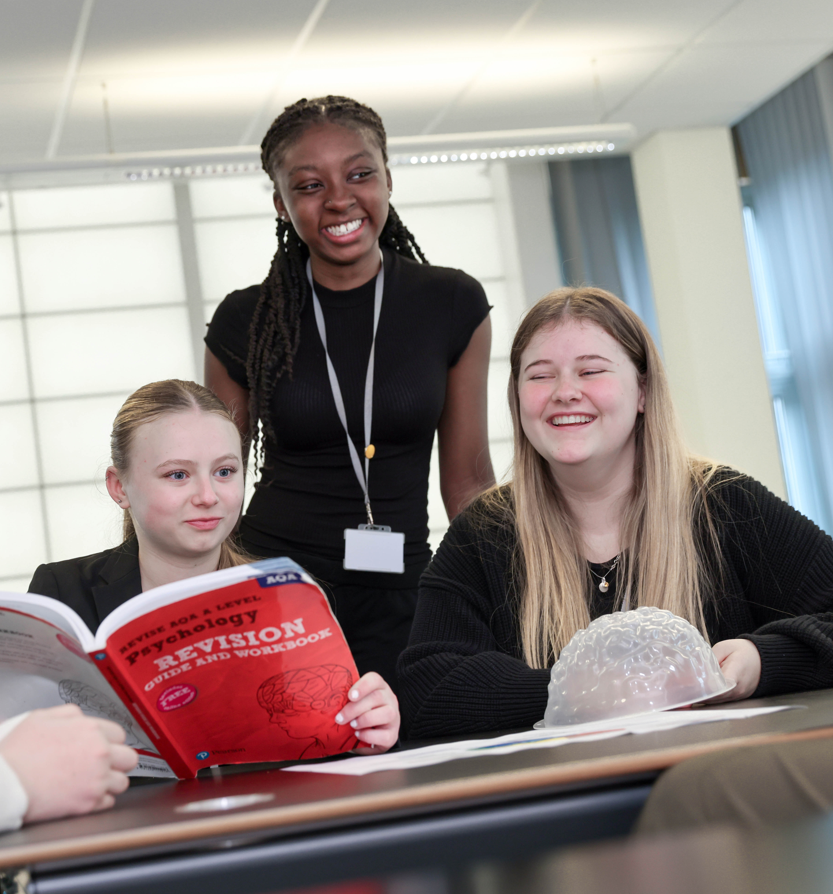
We aim to develop students' higher level skills of evaluation by looking at strengths, limitations and other discussion points such as comparing and contrasting viewpoints throughout the course. This allows them to understand the complexity of psychological issues and move away from simplistic answers towards more developed discussions.
Our ambitious curriculum for Psychology at DSTC is designed to:
- Cultivate a critical understanding of psychological theories and research.
- Encourage analytical, evaluative, and quantitative skills for assessing evidence and conducting research.
- Inspire to consider future careers or studies of Psychology and Science
Complementary Subjects:
- Psychology shares a lot of theories and studies with Criminology when studying Forensic Psychology.
- Health and Social Care and when looking at the study of Clinical Psychology and Mental Health.
- Biology when looking at Biopsychology.
- Business studies and Media are also complementary leading to studying advertising and marketing.
KS5
In Key Stage 5 Students study AQA A level Psychology, which will allow students to study a broad range of areas of psychology such as Attachment, Forensics & Biopsychology. Students will open up many future pathways through the transferable skills they develop throughout this course such as statistical analysis, presentational skills, academic writing, understanding academic literature, being analytical as well as interpersonal skills.
In Year 12 students explore introductory topics in Psychology including memory and social influence. These provide a foundation of knowledge about theories, famous psychologists and classic studies, challenging, analysing and explaining these. In addition, they will start to look at Psychology in context and explore the approaches that underpin all psychological research, allowing them to compare and contrast different points of views and theories.
In Year 13 students look at specific topics and options, starting with a deep dive into Biopsychology delving into the intricate biological machinery that drives human behaviour, from the complex neural networks of the nervous system to the instinctive fight-or-flight reaction. The options that are studied include Forensic Psychology which for many students, complements their other option subjects, schizophrenia and gender. These allow students to hone in on particular topics and use all of their knowledge and skills to apply to real life contexts.
Alongside this students master the essential toolkit of scientific enquiry. Learning about research methods, processes, and data analysis techniques and gaining hands-on familiarity with them, truly understanding their power and their pitfalls.
Psychology students will be encouraged to become independent learners in the hope that they will become interested in researching for themselves the theories and methods that are discussed in relation to current research and information. Leading to students taking University courses in Social Sciences or Psychology, as well as a number of occupations that involve areas of statistical analysis, report writing and communication. Students will develop not only academic excellence but also a deeper, more empathetic understanding of themselves and others.
|
|
Autumn 1 |
Autumn 2 |
Spring 1 |
Spring 2 |
Summer 1 |
Summer 2 |
|
Year 12 |
Paper 1 Social Influence & Research Methods |
Paper 1 Memory & Research Methods |
Paper 1 Attachment & Research Methods |
Paper 2 Approaches & Issues and Debates |
Paper 1 Clinical and Mental Health Psychology & Research Methods |
Paper 2 Biopsychology & Paper 1 consolidation |
|
Year 12 |
Biopsychology & Research methods |
Paper 3 Gender |
Paper 3 Forensics |
Paper 3 Schizophrenia |
Revision |
|
Further Reading/Resources:
Books
- Pearson REVISE AQA A Level Psychology Revision Guide and Workbook
- Psychology: The Science of Mind and Behaviour 8th Edition
- AQA Psychology for A Level : Year 1 and AS Third edition
Websites
- Specification: https://www.aqa.org.uk/subjects/psychology/a-level/psychology-7182/specification/specification-at-a-glance
- Help with content: https://www.tutor2u.net/psychology
- For articles beyond the curriculum https://www.bps.org.uk/psychologist
Other
- Podcast: PsychCrunch
- Magazine: Psychology Review