

Physical Education
Curriculum Intent
We endeavour to provide positive experiences to promote a healthy active lifestyle, which inspires our students to engage in lifelong sport and exercise. Through their studies, they will become more confident, competent and expert learners in a variety of physical activities, sports and skills.
Our expert team of enthusiastic specialists also promote the development of physical literacy and the understanding of sport and exercise through our well considered and tailored Physical Education programme.
In addition to the National Curriculum aims, our ambitious curriculum for PE at DSTC is designed:
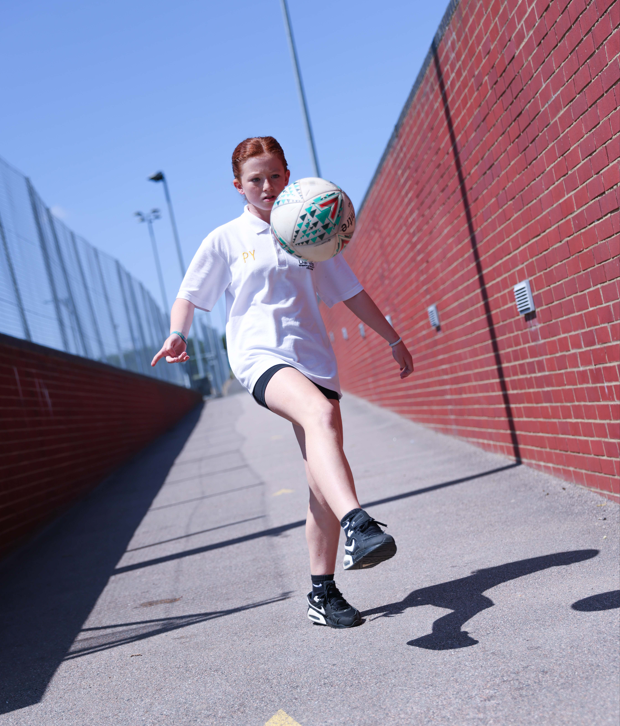
- To nurture a culture that promotes resilience, determination, bravery and confidence to develop their character.
- To enhance social skills such as team work, communication, leadership as well as promote compassion and fair play.
- To provide varied opportunities as well as inclusive experiences in sport through our extracurricular programme, which includes competitive fixtures, clubs and visits.
Complementary Subjects:
- Biology
- Psychology
- Sociology
- Mathematics
- Geography
- Physics
- ICE
- Performing Arts
KS3
Within the Physical Education curriculum our focus is to build on and embed the core skills gained in Key Stage 2 Physical Education. We aim for our Physical Education programme to build on prior learning to provide a seamless transition from primary to secondary and develop a strong foundation for which all physical activities taught can be fully established. At DSTC they will be offered greater exposure to extracurricular activities and competitive situations as well as a broader range of sports.
|
|
Autumn 1 |
Autumn 2 |
Spring 1 |
Spring 2 |
Summer 1 |
Summer 2 |
|
Year 7 |
Games Activities and OAA |
Aesthetic and Fitness Activities |
Athletic and Striking/Fielding Activities |
|||
|
Year 8 |
Games Activities and OAA |
Aesthetic and Fitness Activities |
Athletic and Striking/Fielding Activities |
|||
|
Year 9 |
Games Activities and OAA |
Aesthetic and Fitness Activities |
Athletic and Striking/Fielding Activities | |||
Our aim in Key Stage 3 Physical Education is to promote competence and confidence within our broad and balanced curriculum fostering an enthusiasm for a variety of sports and activities. These include games (netball, basketball, football, rounders, badminton), gymnastics (including trampolining) and athletics based sports, as well as dance, fitness, team building and leadership related sessions. Students may also encounter alternative activities such as cricket, tennis, rugby and dodgeball if time allows.
As part of the Key Stage 3 curriculum, students take part in 2 hours of physical activity a week with an incorporation of Dance into the curriculum. In addition to this, we also offer an inclusive inter-form programme that is organised every term for a different sport. These competitions also encompass House System related events in order to promote house participation and solidarity.
On entering Key Stage 3 our students dive into a range of activities where social, motor and cognitive skills are introduced and built upon. Our students are assessed through three strands which we refer to as Head, Hands and Heart. Lessons provide opportunities for students to develop their character by encouraging and exposing them to competitive, creative and challenging, both team and individual, experiences.
As they advance through the Key Stage 3 curriculum from refining fundamental skills, emphasis is increasingly placed on students embracing different roles and responsibilities within sports. This includes leadership, coaching and officiating. In addition to the programme of study, we also provide students with the opportunity to further elevate their passion for sport and consolidate their practical ability through the participation of a wide range of extracurricular clubs and competitions.
Further Reading/Resources:
- GCSE PE Bitesize – Rules, skills and general information regarding the sports that we cover.
- Women in Sport – 50 Fearless Athletes Who Played to Win – Rachel Ignotofsky
- Sporting Heroes autobiographies
KS4
Core PE
In Key Stage 4 our curriculum is focused upon encouraging students to engage in physical activity in an effective and enjoyable manner, so they can manage the stresses of coursework and exams, but also further develop their physical, cognitive and social skills. Therefore, our lessons not only enable students to consolidate and build confidence in what has been taught at Key Stage 3, but also to introduce some alternative activities.
Students are encouraged to actively suggest a range of sports and activities to partake in, and then alongside their PE teacher, informed choices are made and a curriculum that is appropriate for the class context, ability and interest can be implemented. By the end of their Physical Education at Dartford Science and Technology College we hope that students have been inspired and motivated to maintain a healthy, active lifestyle into adulthood.
|
|
Autumn 1 |
Autumn 2 |
Spring 1 |
Spring 2 |
Summer 1 |
Summer 2 |
|
Year 10 |
Games Activities and OAA |
Aesthetic, Net and Fitness |
Athletic and Striking/Fielding Activities |
|||
|
Year 11 |
Games Activities and OAA |
Aesthetic, Net and Fitness |
Athletic and Striking/Fielding Activities |
|||
Sport Science
Also at Key Stage 4, students have the opportunity to study the Level 2 Cambridge National Certificate in Sport Science. This pathway is suited to highly-motivated sporting students who partake in a large amount of extra-curricular activity or play regular sport outside of school. It provides an educational base to enable each student to progress either to an applied or academic qualification at Level 3. This course involves studying three units, two of which are coursework based and one which is a written examination.
|
|
Autumn 1 |
Autumn 2 |
Spring 1 |
Spring 2 |
Summer 1 |
Summer 2 |
|
Year 10 |
R181 - Applying the principles of training: fitness and how it affects skill performance | R183 - Nutrition and sports performance | R183 - Nutrition and sports performance (Scenario) | |||
|
Year 11 |
R181 - Applying the principles of training: fitness and how it affects skill performance (Scenario) R183 - Nutrition and sports performance (Scenario) |
R180 - Reducing the risk of sports injuries and dealing with common medical conditions | ||||
Further Reading/Resources:
- Level 1/Level 2 Cambridge National in Sport Science (J828): Second Edition Textbook
- Level 1/Level 2 Cambridge National in Sport Science (J828) Exam Practice Workbook
- The Complete Guide to Sports Nutrition – Anita Bean
KS5
At Key Stage 5, we run the Level 3 Cambridge Technical Extended Certificate in Sport and Physical Activity. This qualification is designed with the workplace in mind and provides a high-quality alternative to A Levels. The course provides students with practical opportunities to develop relevant core knowledge and skills. Students further develop their skills through specialist pathways that help them deliver sport and physical activity to a wide range of participants.
This course involves studying five units:
Body Systems and the Effects of Physical Activity (exam) - In this unit, students will gain an understanding of the structures and functions of the key body systems, how these support and impact performance in sport and physical activity, and the effects that physical activity, training and lifestyle can have on them.
Sports Coaching and Activity Leadership – In this unit, students will gain an understanding behind the theory of what makes good sports coaches and activity leaders and methods that can be employed to improve the performance of sports participants.
Sports Organisation and Development (exam) - In this unit, students will gain an understanding of the organisations involved in sport in the UK, their roles and responsibilities and how they work together. They will also gain an understanding of sports development including the organisations involved, who it is targeted at, why sports development is carried out and how the success of sports development initiatives can be measured.
Sports Injuries and Rehabilitation - In this unit, students will be taught how to recognise and treat common sports injuries both immediately and through longer-term rehabilitation programmes, what the possible psychological impacts of sports injuries are, and how to minimise the risk of sports injuries occurring in the first instance.
Organisation of Sports Events - In this unit, students develop skills in planning, promoting and delivering a sports event, with a focus primarily on their individual role as well as working as part of a team and reflecting on their input and future personal development.
Upon completion our students will be able to progress further in education including University level courses, because this course is equivalent to one A Level and it attracts equivalent UCAS points. Alternatively, they may choose to start working in the sporting sector. Related careers include: Coaching, Teaching and Instructing; Physiotherapy, Osteopathy, Personal Training; Leisure Management; Sports Development; Armed Forces; Outdoor Education.
|
|
Autumn 1 |
Autumn 2 |
Spring 1 |
Spring 2 |
Summer 1 |
Summer 2 |
|
Year 12 |
Unit 1 - Body Systems and the Effects of Physical Activity (exam) Unit 2 - Sports Coaching and Activity Leadership |
Unit 17 - Sports Injuries and Rehabilitation | ||||
|
Year 13 |
Unit 3 - Sports Organisation and Development (exam) Unit 17 - Sports Injuries and Rehabilitation |
Unit 8 - Organisation of Sports Events | ||||
Further Reading/Resources:
- Cambridge Technicals Level 3 Sport and Physical Activity Textbook
- The Anatomy of Sports Injuries – Brad Walker